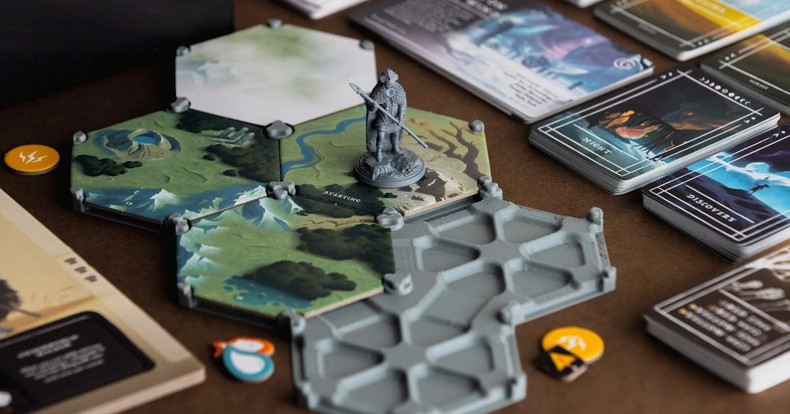
Shifting landscapes in the tabletop gaming world frequently see ambitious cooperative campaigns arrive with massive promises of grand scope, but few titles manage to deliver on that scale with the artistic precision of Stonesaga. Created by the brilliant design duo of Luke Laurie and Max Pears, this sprawling cooperative survival game completely upends the traditional legacy genre by shifting the focus away from individual characters and centering it entirely on the generational survival of a single human tribe. Set in a beautifully desolate, glacial valley surrounded by towering peaks, the game forces players to guide a community from its prehistoric infancy through centuries of technological breakthroughs, environmental shifts, and encounters with awe-inspiring, god-like behemoths. It is a stunning, deeply tactile experience that treats societal evolution as the ultimate cooperative puzzle.
Trading standard worker placement for societal evolution
Stepping into this meticulously designed universe reveals a brilliant mechanical synergy between two of the industry’s most inventive designers. Laurie, celebrated for engineering the tight, engine-building mechanics of Dwellings of Eldervale, joins forces with Pears to craft an innovative "epistolary legacy" system. Instead of permanently destroying components or altering a fixed map, players make permanent cultural discoveries that are written directly into the tribe's ongoing oral history. Every successful hunt, tragic famine, or discovered tool alters the collective knowledge base, directly dictating what subsequent generations can build or craft centuries later. It is a masterful subversion of standard legacy mechanics that emphasizes legacy over destruction, making every victory or failure feel monumentally historical.
A dynamic, living ecosystem challenges your basic instinct
Exploring the harsh mechanics of the glacial valley means mastering a beautifully complex, resource-driven survival loop. The board state functions as a living, breathing ecosystem where the weather actively changes, resource nodes deplete, and massive, wandering monsters alter the terrain simply by moving across it. Players must work together to split tasks—sending some tribal members to gather rare components, others to research advanced stonecraft, and a dedicated hunting party to track prey. The game introduces a brilliant physical tracking mechanic where tools wear down and resources spoil if not utilized or preserved correctly. This constant pressure creates a brilliantly tense tabletop environment where short-term panic must always be balanced against the long-term survival of future generations.
Honouring the roots of cooperative gaming
Constructing a narrative across thousands of years allows the game to pay a beautiful, sophisticated homage to the rich heritage of cooperative survival board games. While classic titles like Robinson Crusoe focused heavily on the immediate, frantic panic of surviving the night, this title elevates the stakes to a grand, cinematic scale reminiscent of deep-world video game simulations like RimWorld. The decisions you make in the opening era—such as whether to domesticate a local animal species or drive it to extinction—completely alter the mechanical makeup of the game pieces available in the final eras. By treating the player's tribe as a shifting, evolving organism that grows more complex with every single game night, the designers have created a definitive high-concept masterpiece that sets a new gold standard for thematic campaign gaming.
Stonesaga Inspo & Insight: The gorgeous, distinct visual identity of the game's colossal monsters draws deep creative inspiration from ancient Inuit and Pacific Northwest indigenous mythologies. Rather than populating the valley with standard, aggressive fantasy dragons, the artists deliberately designed the beasts to look like living extensions of the earth itself, combining elements of ancient stone, moving glaciers, and weathered timber to make them feel like majestic, sacred forces of nature!